
 The shift is seen by tech journalists to be in-line with recent trends in the market reeling from the popularity of netbooks. Though netbooks are seen as under-powered when compared to mainstream notebooks, the low price point has induced tremendous growth in adoption by consumers. It has also caused notebook manufacturers to rethink how they market ultra-thin notebooks, formerly known as ultra-portables, because of the close similarities in form factor.
Think about it. Five years ago ultra-thin notebooks were considered premium notebooks, priced well above mainstream notebooks. Just take a look at PC World or PC Magazine for reviews of ultra-portables released around 5 years ago and you'll see what I mean. With the creation of a new niche for netbooks, with screen size ranging from 7-11", ultra-thin notebooks with 12-13" LCD's were on the verge of gathering dust in store shelves and stock rooms. To a prospective buyer, they'd rather have a smaller screen if it means they can tote it around and not pay a premium for it. They would have fewer qualms about it being slower if it's a whole lot cheaper.


 Because of that, manufacturers have of late been repositioning the ultra-thin notebooks in a performance and price niche slightly above netbooks but with less power than mainstream notebooks. Their main selling points have been maintained though - low-power consumption that extends battery life and small form factor that makes it light and very portable. Screen sizes are still 12-13", which snugly fits the niche between netbooks and mainstream laptops. To give you a sense of what your money can fetch for you, you can get an Intel CULV-powered MSI x400 for $390
 now. An AMD Neo-powered MSI U210 sells for about $407
 . Both definitely have more powerful processors than the Atom on netbooks. Both have lithe frames, slightly better video and slightly larger LCD's than netbooks. Battery performance is better on netbooks with smaller screens, but CULV laptops still have it better than mainstream notebooks. If you've got the money, you can go a more powerful Core 2 Duo SU7300 CULV processor like the one they packed on the MSI X350
 . It costs $890, still in the mainstream notebook price range, but as portable as any 13" laptop you'll find. There's also the 11" Alienware m11x for those who cannot do without World of Warcraft on the road. The Alienware m11x will set you back $799 for the base model.
Intel's announcement of cheaper, more power-efficient CULV processors to beef up it latest generation will make for cheaper ultra-thin notebooks. There are also several laptops powered by the latest generation of AMD Neo processor (take for example MSI's U230

 ) that will compete with Intel's CULV offerings. This will make for more products choices should you want to get something with a little more processing heft than a netbook. Bottom line, more choice is always better for us consumers.


 SSD's offer speeds at par with your system memory or RAM. To give you a sense of how fast that is in practical terms, say you installed Windows on an SSD. If you click on an icon to launch your browser, it will launch in 1-2 seconds. Compare that to 3-5 seconds when your Windows is installed on a regular spindle drive. That's one heck of a performance boost, wouldn't you say? It also consumes less power, owing to the fact that it does not have any moving parts. That makes it ideal for stretching battery life in between charges in notebooks.
 , or US$3.12 per GB. The OCZ Onyx, touted as one of the first sub-$100 SSD, is currently priced at
  . The cheapest still goes for about US$3 per GB, roughly Php126 and change per GB. At that price point, the money you'll shell out for a 40GB SSD will fetch you a
  in comparison. The prices have been coming down in the last few months as manufacturing costs are brought down by new advancements. However, don't expect them to be as affordable as spindle drives any time soon.

 I've been mulling over buying one for the past months. I have an Atom desktop that I chose to build precisely because of it's thrifty use of power. Adding an SSD to my rig would increase the power savings and lower the temperature inside the case. Using an SSD as a boot drive, the Seagate 500GB drive I currently have would make a great secondary drive for data. For these tough times though, value for money is still the priority. Speed will have to wait, at least for now.

 This morning, I had a little spare time to clean the computer. I hadn't opened it since I had the motherboard replaced some 2 months back. I was quite surprised by the amount of dust that had collected inside the case. It was probably because I bought an additional high-RPM exhaust fan that increased the airflow inside the case. I bought a
  . I installed the XFan5 because I needed to make sure that temperatures inside the case won't go up if the chipset fan on my
  and
and 
 Running the fan caused dust to accumulate at the mounting brackets nearest the side panel vent holes. Dust was also starting to carpet the lower panel of the case. I busted out the
  , popped open the side panel and took the computer outside. I took out the mounting bracket and dusted the insides with a clean old paintbrush. I couldn't get to the chipset heatsink though I managed to clean the fan on it. One of those
 , but with the
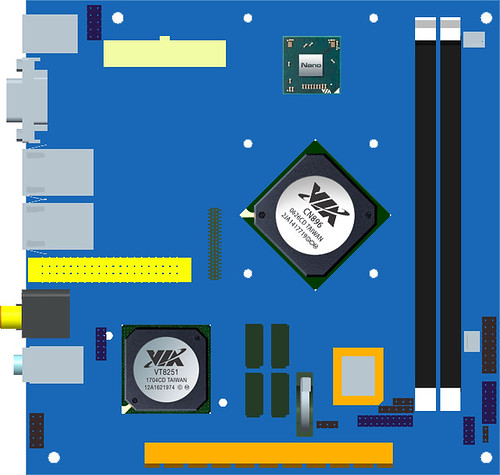


 late last year and the
 .
. directly, but rather with pricier


 Posts
Posts


