Showing posts with label NVIDIA. Show all posts
Showing posts with label NVIDIA. Show all posts
Via Nano Running Crysis
Tuesday, June 10, 2008
0 comments
Found a video of the demo Via Nano unit I blogged about 2 days ago. The video is posted along with first-hand accounts of the event and it's posted on TweakTown. I must say I'm impressed. This platform might prove its worth and become Via's chance to really make an impact in mainstream PC market.


Via And NVidia Launch Mini-ITX 2.0
Sunday, June 8, 2008
0 comments As was previously announced, Via and Nvidia officially came out and formally presented their partnership to produce the most affordable Vista-capaable platform. PC Perspective ran a story with in-depth information on the expected performance of the upcoming platform. They even posted a picture of a sample board, with an 8600GT strapped on to the PCI Express slot. Digitimes also ran a story on the announcement, highlighting the two's support of Mini-ITX 2.0. Intel's entry to the Mini-ITX niche has been observed as "limiting", having a very basic graphics subsystem and no provisions for upgrades. Seeting up an official spec for Mini-ITX 2.0 is seen by analysts as Via's play to keep its dominance over it's Mini-ITX turf while attracting more of the mainstream market.
Mini-ITX 2.0 seeks to up the ante by allowing consumers more mainstream expansion choices while maintaining the 17 x 17 cm form factor. In more detail, 2.0 will require the following feature set on boards:
- Processor: High-performance, power efficient x86 processor, such as the VIA Nano processor;
- Memory: Support for minimum 2GB DDR2 SDRAM;
- Graphics: DirectX 9.0 integrated (IGP); DirectX 10 through an add-in card;
- Display: 1 VGA port for LCD display; 1 HDMI port on add-in card;
- HD Audio: 3 Audio jacks for up to 6-channel surround sound;
- Broadband Connectivity: 1 Gigabit Enthernet port;
- Storage: 2 Serial ATA II slots + 1 IDE (PATA) slot;
- Peripheral Connectivity: Minimum 4 USB2.0 ports;
- Expansion: 1 PCI Express 16-lane slot;
- Size: 17cm x 17cm;
- O/S Support: Microsoft Windows Vista; Microsoft Windows Vista Premium (through an add-in graphics card); Microsoft Windows XP, and major Linux distributions such as Ubuntu, Suse Linux and gOS;
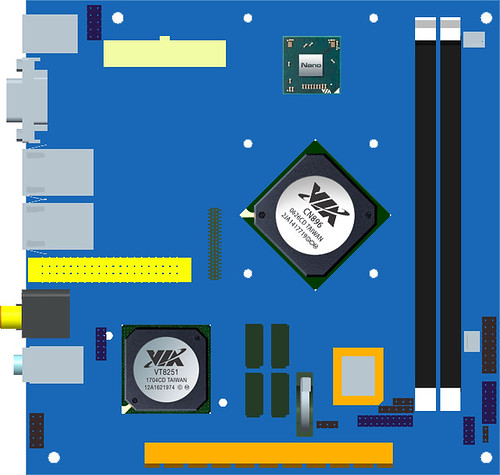 When compared to the current Mini-ITX offerings of Intel, these specifications are a boon for anyone seeking a low-cost solution for multimedia and gaming on the Vista platform. Clearly this strategy can open up a niche for Via in the mainstream market, opposite Intel's pushing the Atom platform (and their other Mini-ITX offerings) in the low-power niche that Via traditionally dominated. Now, only the market will say who's strategy will eventually pay off. Who gains more is will eventually be dictated by the consumers. I'm hedging my bets on Via gaining a bit on the mainstream market.
Via Lines Up Its Nano (Isaiah) Processors
Saturday, May 31, 2008
0 comments
Via made the headlines as it announced its line up of Nano processors. These were codenamed 'Isaiah' during its development. The web is awash with news from different sources, all chiming in their perspective of the future of the Nano processor. Infoworld, PC Pro, PC Perspective, PC Magazine, IT Pro and Trusted Reviews and CRN.com all did stories on it.
The Nano line will include two sets, the L-series on the high-power end and the U-series for low-power segment. The L-series will still have a lower power consumption than mainstream Intel and AMD chips, churning at 25 watts. The following variants are planned for the Nano:
- L2100 (Clock Speed: 1.8 GHz, TDP: 25 watts)
- L2200 (Clock Speed: 1.6 GHz, TDP: 17 watts)
- U2400 (Clock Speed: 1.3-plus" GHz, TDP: 8 watts)
- U2500 (Clock Speed: 1.2 GHz, TDP: 6.8 watts)
- U2300 (Clock Speed: 1.0 GHz, TDP: 5 watts)
$300-ish Budget PC
Sunday, April 20, 2008
0 comments Hot on the heels of my post on building a relatively cheap dual-core system that can double as a multimedia machine, I've decided to post what I'm recommending to a friend looking to build a budget system. Considerations for this build were the common tasks this machine was going to be used for. He would use it to play DVD's, internet browsing and office work. His wife would use it for her Adobe Photoshop projects and printing.
I recommend this set-up because of the low-power draw from this AMD AM2 ATHLON 64 LE-1620. Another side benefit of choosing this particular processor is its ability to overclock, should the need arise that is. These processors actually overclock quite a bit, as proved by this post in XtremeSystems.org. The memory requirement for this is build is kept to a single 1GB DDR2 module from Geil because he'll be using Windows XP
 . Together with the software he will be using, a Gig is comfortable enough. Storage is relative conservative as well, owing to the fact that he won't be storing multimedia content. He'll be playing DVD's and storing family pictures. That's it. Before he uses up the space on that 160GB Seagate drive
 , prices for the 500 GB SATA drive would have dropped and an upgrade would be relatively cheap. The LG GSA-H55N will allow him to back-up his data and movie downloads. Playback on a living room DVD set-top unit is also a consideration so DVD±RW burner would be ideal.
These specs may seem sparse, but the main consideration is to keep the budget around the Php 10,000 mark. That's sub-$300 to you folks in the US. The following hits it right at the sweet-spot:
- AMD AM2 ATHLON 64 LE-1620 2.4 GHz
- PhP 2,100
- EMAXX NF7050HD-PRO VGA/ LAN / PCI-E - PhP 2,350
- 1 GB GEIL DDR2 PC800 - PhP 1,100
- 160GB Seagate Barracuda 7200RPM SATA
- PhP 2,100
- 20x LG GSA-H55N DL DVD±RW IDE Drive
- PhP 1,250
- Generic ATX Steel Case
- PhP 1,500
- TOTAL - Php 10,450
 would be comparable, albeit pricier option. Also, Geil RAM isn't so popular in the US either. Kingston ValueRAM
 would be of a comparable quality and more widely available. Going by US prices, this build would cost around $340.00 and a few cups of coffee.
So there you go.
NVIDIA-Via Join Forces to Fend Off Intel and AMD
Monday, April 14, 2008
0 comments NVIDIA has released more details about the much-touted tie-up with Via in this article from CNET.com. The deal would pit a combo of NVIDIA's soon to be released IGP and Via's Isaiah with the existing discreet graphics products of AMD and Intel. This comes at a crucial time for NVIDIA. Analysts are starting to question the long-term viability of their products in the face of increasing consolidation on the part of AMD and Intel to include graphics into their individual product offerings.
To stress the cost benefits of this future platform, NVIDIA is drawing direct cost comparisons with Intel's existing IGP solutions for multimedia-enabled machines. They say their solution would perform better compared to a similarly-priced option from Intel. Here's a copy of the comparison they presented to analysts at a recent event:

This development is an interesting historical point in the evolution of the role IGP solutions will play in the ever-heightening green consciousness of consumers. It also emphasizes the need for cheaper but better hardware to deal with the demand of current household computing needs. To be more specific, today's computer must be able to play multimedia content and be cheap enough to be adopted in the home. NVIDIA and Via are in effect creating a product platform that will appeal to both green computing advocates and cost-conscious consumers. This post in Ubergizmo also opines that this increases NVIDIA's chances of fending off moves by Intel and AMD to consolidate graphics into their own platforms, thus ensuring they will still be relevant to the PC for the foreseeable future.
I think I'll put off upgrading until this is released. This is even better than I had hoped for. The low-power features of Via's Isaiah combined with NVIDIA chipset. Having both in a single board will surely perform well on the graphics end and still save on power consumption. This will turn out as the perfect solution for my needs. I'm thinking a Zonbu based off this platform would be even better.
Subscribe to:
Posts (Atom)


 Posts
Posts


