With Intel positioning its Atom and Via competing with it with the Nano, the public is wondering what AMD is planning for serving the UMPC and low-power segments. I only recently learned of 'Bobcat', AMD's platform designed from the ground up for ultra-mobile PCs, devices and consumer electronics. Basically, its a re-designed x86 processor optimized for low-power devices with a TDP of 1 to 10 watts. It's being developed in parallel with Bulldozer, a seperate processor platform aimed at low-power desktops. In contrast, Bulldozer will have a TDP of 10 to 100 watts and a CPU-integrated GPU core that's squeezed right into the processor piece. Both are projected to launch in 2009, but by the way things are going, AMD should launch them earlier if they want to catch up.
Register Hardware ran a story on this last year. A more exhaustive article on Anandtech discusses the platform as a whole, with information interspersed with details from interviews they conducted. Another article from Tech Report discussed the technical merits of the platform when it was first revealed.
Showing posts with label UMPC. Show all posts
Showing posts with label UMPC. Show all posts
Via Nano Running Crysis
Tuesday, June 10, 2008
0 comments
Found a video of the demo Via Nano unit I blogged about 2 days ago. The video is posted along with first-hand accounts of the event and it's posted on TweakTown. I must say I'm impressed. This platform might prove its worth and become Via's chance to really make an impact in mainstream PC market.


Via And NVidia Launch Mini-ITX 2.0
Sunday, June 8, 2008
0 comments As was previously announced, Via and Nvidia officially came out and formally presented their partnership to produce the most affordable Vista-capaable platform. PC Perspective ran a story with in-depth information on the expected performance of the upcoming platform. They even posted a picture of a sample board, with an 8600GT strapped on to the PCI Express slot. Digitimes also ran a story on the announcement, highlighting the two's support of Mini-ITX 2.0. Intel's entry to the Mini-ITX niche has been observed as "limiting", having a very basic graphics subsystem and no provisions for upgrades. Seeting up an official spec for Mini-ITX 2.0 is seen by analysts as Via's play to keep its dominance over it's Mini-ITX turf while attracting more of the mainstream market.
Mini-ITX 2.0 seeks to up the ante by allowing consumers more mainstream expansion choices while maintaining the 17 x 17 cm form factor. In more detail, 2.0 will require the following feature set on boards:
- Processor: High-performance, power efficient x86 processor, such as the VIA Nano processor;
- Memory: Support for minimum 2GB DDR2 SDRAM;
- Graphics: DirectX 9.0 integrated (IGP); DirectX 10 through an add-in card;
- Display: 1 VGA port for LCD display; 1 HDMI port on add-in card;
- HD Audio: 3 Audio jacks for up to 6-channel surround sound;
- Broadband Connectivity: 1 Gigabit Enthernet port;
- Storage: 2 Serial ATA II slots + 1 IDE (PATA) slot;
- Peripheral Connectivity: Minimum 4 USB2.0 ports;
- Expansion: 1 PCI Express 16-lane slot;
- Size: 17cm x 17cm;
- O/S Support: Microsoft Windows Vista; Microsoft Windows Vista Premium (through an add-in graphics card); Microsoft Windows XP, and major Linux distributions such as Ubuntu, Suse Linux and gOS;
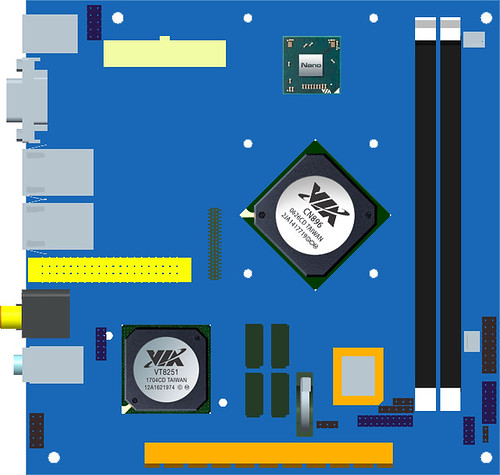 When compared to the current Mini-ITX offerings of Intel, these specifications are a boon for anyone seeking a low-cost solution for multimedia and gaming on the Vista platform. Clearly this strategy can open up a niche for Via in the mainstream market, opposite Intel's pushing the Atom platform (and their other Mini-ITX offerings) in the low-power niche that Via traditionally dominated. Now, only the market will say who's strategy will eventually pay off. Who gains more is will eventually be dictated by the consumers. I'm hedging my bets on Via gaining a bit on the mainstream market.
Eee Box - Asus' Eee PC Comes to Desktops
Friday, June 6, 2008
0 comments
I read about the Eee Box from three articles several days ago. CNET, ZDNet and HotHardware all had articles pointing to emerging details about the Eee Box. Even Gizmodo had a few words to say about it. I must say it reminds me of the HP Blackbird, but that is altogether a different kind of machine.
Anandtech had a much more exhaustive feature on it. They benchmarked a demo unit. The article established the price point and corresponding configurations. The Anandtech article mentioned that all three units will b powered by an Intel Atom processor clocked at 1.6GHz. There will be a $269 base unit that will come with 1GB of RAM, an 80GB 2.5" laptop hard drive and Linux pre-installed. A Windows XP unit with the same spec will retail for $299. A third variant with Linux pre-installed will have the same $299 price tag as the XP unit but will have double the RAM and hard disk space. Goes to show how much you're really saving when you go for Linux ;-)
No fresh news is forthcoming, though. But I'll be watching.
Via Lines Up Its Nano (Isaiah) Processors
Saturday, May 31, 2008
0 comments
Via made the headlines as it announced its line up of Nano processors. These were codenamed 'Isaiah' during its development. The web is awash with news from different sources, all chiming in their perspective of the future of the Nano processor. Infoworld, PC Pro, PC Perspective, PC Magazine, IT Pro and Trusted Reviews and CRN.com all did stories on it.
The Nano line will include two sets, the L-series on the high-power end and the U-series for low-power segment. The L-series will still have a lower power consumption than mainstream Intel and AMD chips, churning at 25 watts. The following variants are planned for the Nano:
- L2100 (Clock Speed: 1.8 GHz, TDP: 25 watts)
- L2200 (Clock Speed: 1.6 GHz, TDP: 17 watts)
- U2400 (Clock Speed: 1.3-plus" GHz, TDP: 8 watts)
- U2500 (Clock Speed: 1.2 GHz, TDP: 6.8 watts)
- U2300 (Clock Speed: 1.0 GHz, TDP: 5 watts)
Via Introduces OpenBook Mini-Note
Monday, May 26, 2008
0 comments
Via introduced the latest iteration of it's OpenBook series of ultra-mobile PCs, the OpenBook Mini-note. The reference design has an uncanny resemblance to the form factor of the HP 2133 Mini-Note, with the exception of the faster processor. Both designs share the 8.9" LCD screen configuration, with the Mini-note upping the ante by having provisions for built-in broadband connectivity to WiMAX, EV-DO, W-CDMA, or HSDPA services in addition to the now standard WiFi through a factory-configurable device module.
The Mini-note will be powered by a 1.6 GHz VIA C7-M ULV processor and will accommodate up to 2GBs of RAM. This is an offshoot perhaps of the decision to make it capable of supporting Windows Vista. Though the VIA VX800 Digital Media IGP chipset it has for video isn't the most powerful in the mobile computing space, it will certainly be enough to support DirectX 9.0 3D graphics up to a resolution of 1024x600. That being said, I would opine that it would comfortably work with MPEG-2, MPEG-4, WMV9, VCI and DiVX for the multi-media entertainment needs of prospective owners.
It would be exciting to see what final product OEM's and ODM's could produce from the reference design.
Isaiah, Where Art Thou?
Tuesday, May 20, 2008
0 comments
A lot of news recently about Via's other products(most recently, its latest Pico-ITX board), but nary one about Isaiah-based products. Most of articles about the Isaiah have to do with conjecture at this point. No product announcements of any sort. That's opposed to Intel's Atom, with a few final products already announced and waiting to be launched. One of them, MSI's Wind was already launched in some countries, AFAIK. No announcements have been made of any Isaiah-powered product that will launch in the next few weeks.
When will they launch an updated Zonbu Mini Desktop with Isaiah in it? Any products that will compete with say the likes of the MSI Wind? Or at least a Via Artigo powered by the Isaiah chip? I'm waiting, still.
Via Isaiah, Intel Atom Benchmarked
Saturday, April 19, 2008
0 commentsEngadget linked to a translated German site showing that the Via Isaiah edged out Intel's Atom in benchmarks they performed. Now, these results may seem slanted towards making Isaiah look good, but bear in mind that these tests performed were limited to ALU and FPU benchmarks. One CPU is bound to get an edge over the other depending on how the internal instructions of the chips handle math and so forth. I guess every geek out there who has staked an interest in these low-power processors is waiting for a more conclusive set of benchmarking, but that'll come in time. These chips aren't as widely available as we'd like, after all. Most of the samples (for both) have been sent to manufacturers, OEM's and ODM's. As the market churns out UMPCs, mobile phones and sub-notebooks using these 2 processors, more extensive benchmarks can be performed. I eagerly await for that to come.
Here's a screenshot of the result from the benchmarking they performed:

Cloudbook Max Announced
Saturday, April 12, 2008
0 comments
Ars Technica broke the news that Everex announced the 2nd-generation to follow the Cloudbook. The 10-incher they're calling the Cloudbook MAX is a bit larger than its older brethren. It does up the ante as well when it comes to connectivity. It will have an embedded mobile WiMAX chip which will allow access to Sprint's XOHM broadband service. Other hardware highlights would be the 1.6GHz VIA C7-M Processor ULV, 1GB DDR2 533MHz SDRAM (up to 2GB), 80GB Hard Disk Drive, 8.9"WVGA TFT Display (1024 x 600 supported). The unit will ship with Windows Vista Home Basic.
Ars Technica does caution that Everex may have jumped the gun when they announced this, as the Cloudbook MAX is set to launch sometime early 2009. I'm thinking along the same lines. I'm also wondering about their choice of operating systems for this unit. Vista would run slow on a machine this spartan. Wouldn't it make for a better user experience if they just ship it with an updated version (hence, snappier) of gOS Linux? We are talking of a 2009 launch date, so that may change with time.
UMPC's Hit the Philippines
Friday, April 11, 2008
0 comments
On my way home I bought a copy of the latest PC Buyer's Guide. It's a month old, but as things go this magazine's always late to arrive on store shelves. Anyway, I was gladly surprised that local brands have been eagerly tailgaiting the success of the Asus Eee PC. They've come out with their own UMPCs.
I have been writing a lot about UMPCs lately because of my personal interest in low-power devices. I've always envied geeks in the US, specifically because new products frequently grace their shores earlier than Asian countries. The Asus Eee PC started a different trend, launching first in Taiwan, where Asus is considered as superstar computer company. And so it's success in the Philippines has opened the doors wide for other brands to get in on the UMPC bandwagon.
Two of these brands are Redfox and Astone. I've known Redfox for years. I started seeing motherboards under that brand as early as my freshman year in college. It was only after I built my first PC some 5 years ago that I realized that Redfox was actually a brand that went to ODMs and OEMs for the actual manufacture of their products. I've since used 2 Redfox motherboards and 1 Redfox ATX case to build machines. My current machine uses what's called the Biostar NF61S Micro in other countries. Astone is another brand that has successfully made a good break in the local PC and gadget market. I currently have an ATX case that's sold under their brand.
Now back to UMPCs. Redfox has 2 entries to the Philippine UMPC segment. The Wizbook 800 and the Wizbook. The specs are as follows:
WizBook 800
WizBook
I have been writing a lot about UMPCs lately because of my personal interest in low-power devices. I've always envied geeks in the US, specifically because new products frequently grace their shores earlier than Asian countries. The Asus Eee PC started a different trend, launching first in Taiwan, where Asus is considered as superstar computer company. And so it's success in the Philippines has opened the doors wide for other brands to get in on the UMPC bandwagon.
Two of these brands are Redfox and Astone. I've known Redfox for years. I started seeing motherboards under that brand as early as my freshman year in college. It was only after I built my first PC some 5 years ago that I realized that Redfox was actually a brand that went to ODMs and OEMs for the actual manufacture of their products. I've since used 2 Redfox motherboards and 1 Redfox ATX case to build machines. My current machine uses what's called the Biostar NF61S Micro in other countries. Astone is another brand that has successfully made a good break in the local PC and gadget market. I currently have an ATX case that's sold under their brand.
Now back to UMPCs. Redfox has 2 entries to the Philippine UMPC segment. The Wizbook 800 and the Wizbook. The specs are as follows:
WizBook 800
- Processor: AMD Geode LX700 L1 & L2 cache 128kb, 400Mhz
- Memory: 256 MB
- Hard Drive: 20GB Nandflash
- Display: 8" WXGA TFT Screen
- Lan: RJ-45
- Modem: 802.11b/g wireless PCMCIA slot
- Battery: 2200mAh
- Weight: Under 1.2 Kg
- Other : SD/MMC/MS CARD reader, DC in 12V, 2xUSB slot, microphone input
WizBook
- Processor: AMD Geode LX800 L1 & L2 cache 128kb, 500Mhz
- Memory: 512 MB
- Hard Drive: 60GB Nandflash
- Display: 10.2" WXGA TFT Screen
- Lan: RJ-45
- Modem: 802.11b/g wireless PCMCIA slot
- Battery: 2200mAh
- Weight: Under 1.2 Kg
- Other : SD/MMC/MS CARD reader, DC in 12V, 2xUSB slot, microphone input
- Processor: VIA C7-M ULV 1.2Ghz (FSB400) on-board
- Chipset: VX700
- Graphics: integrated VX700
- Audio: VT1708A, with 2 internal 1.5W built-in speaker
- Memory: 1GB DDR 667
- HDD: 30GB (1.8" HDD)
- Monitor: 7" LCD Touch Screen with Handwriting capability, WVGA 800x400
- LAN: 10 Base-T/100 Base TX LAN
- Bluetooth: Yes, USB interface
- Modem: none
- Wireless LAN: Yes, IEEE 802.11b/g, USB 2.0 mini card
- Battery: 4-cell 2200mAh
- I/O: DVi-I, USB 2x, mic-in/Array Mic 1x, Headphone out/Line-out 1x, RJ45 1x
- Webcam: Yes, built-in 0.3MP Camera
- Card Reader: Yes, 4-in-1 (for SD, MMC, MS, MS Pro)
- Dimension: 9.1" x 6.7" x 1.16" (230x171x29.4mm)
- Weight: 0.97kg
More on the HP 2133
Thursday, April 10, 2008
0 comments
Found 2 other articles on PCWorld about the HP 2133 Mini-Note.
Sumner Lemon spoke with Philip Devlin of HP about rife speculation that a future version of the HP 2133 would be fitted with the Via Isaiah processor. That would be relatively easy since the Via Isaiah is compatible with existing boards that support the C7-M.
Another article by Glenn Fleishman reviews the cost-vs-specs aspect of the unit. He compares it to other laptops straddling the UMPC demarcation line, pointing out that these are relatively under-powered when compared to ordinary laptops. But he conceeds that as trends go these days, buyers are willing to trade off processing heft for added portability.
Fleishman also links to a video review by Darren Gladstone that compares the HP 2133 head-to-head with the Asus Eee PC. Darren loves the keyboard, but hates how slow it is at running Vista Business. Well, good thing Suse Enterprise Desktop 10 is offered as an option to Vista Business ^_^ SLED 10 would run a lot better on the HP 2133. A whole lot better.
Mandriva 2008 Spring
Wednesday, April 9, 2008
0 comments
I just read the announcement that Mandriva released 2008 Spring (ver. 2008.1?). I was surprised to find a few interesting items in the list of things they've improved in this release. Notably they have now have parental controls, media server capabilities and better synchronization support with mobile devices built-in. Sadly Palm is not included in the list of devices that 2008 Spring provides "Easy support for synchronizing" for. Another noteworthy item is the out-of-the-box support for the Asus Eee PC. Mandriva touts that 2008 Spring "works perfectly on the Eee PC with no modifications" needed. I think I'll be busy during my offs trying out Mandriva and DreamLinux ^_^
By the way, you can check for screenshots of the beautifully designed desktops here: KDE, Gnome, Xfce. If your interested in trying out Mandriva 2008 Spring, you can download your free copy from here.
By the way, you can check for screenshots of the beautifully designed desktops here: KDE, Gnome, Xfce. If your interested in trying out Mandriva 2008 Spring, you can download your free copy from here.
HP Mini-Note (HP 2133) Released

PC World had posted a product review of the HP 2133. The rest of blogosphere was quiet though. I barely managed to find a press release. I've been watching out for the release of this product because it belongs to a new class of computing hardware. These devices (UMPC's and net-connected devices) optimize power consumption, portability and cost. I was surprised that there wasn't much press about the launch. Oh, well. It's the Engadget effect. They break news about upcoming products that by the time the thing actually launches the hype is almost over.
It's listed on Amazon.com now, by the way: Mini-Note PC C7-M 1.2GHz 120GB

Classmate PC Whitebook
Tuesday, April 8, 2008
0 comments
Last Friday, I posted on Twitter that I saw a Philippines whitebook version of the popular Intel Classmate PC. I had promised to post a picture online, but forgot to because of the accident we were involved in (I blogged briefly about it here and here).
Well, here it is. The Neo Explore X1:

It was rather fortunate though that I posted about it a few days later. I now know that the unit I saw was from the 2nd generation of the Classmate PC. I confirmed that when I checked the specs here. The specs are as follows:
You'll also notice (in the pic above) that the X1 is sitting right beside an Asus Eee PC. Rather tongue-in-cheek if you asked me. While they share the same roots, starting off as laptops for students who don't necessarily need that much processing power for classroom computing, the Asus Eee PC has been adopted by both geeks and ordinary people alike because of its low price and conservative styling. Even with it's diminutive dimensions, the Asus Eee still looks and feels like a traditional laptop (sans the full-sized keyboard, that is).The Classmate exudes a toy-ish feel. Kinda looks like a VTech toy laptop for toddlers.
For the general laptop-using internet-surfing public, the only edge Classmate PC has over the Asus Eee would be its 30 GB of storage. That's huge compared to the paltry 4GB of the Asus Eee PC. It makes it more flexible when it comes to saving your work or files. Both laptops have their own selling points. It'll come down to what's important to you.
Comments? Which would you consider buying? What everyday computing tasks would you use it for?
Well, here it is. The Neo Explore X1:

It was rather fortunate though that I posted about it a few days later. I now know that the unit I saw was from the 2nd generation of the Classmate PC. I confirmed that when I checked the specs here. The specs are as follows:
- Processor: Intel Celeron M ULV 353
- Processor Speed: 900 Mhz clock speed, 400 Mhz FSB
- Chipset: Intel GMS915 + ICH6-M
- Memory: 512 MB DDR2
- Display: 7" 800 x 480 LCD
- Hard Disk Drive: 30 GB
- Networking: 10/100 Mbps LAN
- Wireless: 802.11 b/g WiFi
- Card Reader: SD/MMC Card Reader
- Battery: 6-cell battery, 3-4 hours
- Weight: ~ 1.45 kg
You'll also notice (in the pic above) that the X1 is sitting right beside an Asus Eee PC. Rather tongue-in-cheek if you asked me. While they share the same roots, starting off as laptops for students who don't necessarily need that much processing power for classroom computing, the Asus Eee PC has been adopted by both geeks and ordinary people alike because of its low price and conservative styling. Even with it's diminutive dimensions, the Asus Eee still looks and feels like a traditional laptop (sans the full-sized keyboard, that is).The Classmate exudes a toy-ish feel. Kinda looks like a VTech toy laptop for toddlers.
For the general laptop-using internet-surfing public, the only edge Classmate PC has over the Asus Eee would be its 30 GB of storage. That's huge compared to the paltry 4GB of the Asus Eee PC. It makes it more flexible when it comes to saving your work or files. Both laptops have their own selling points. It'll come down to what's important to you.
Comments? Which would you consider buying? What everyday computing tasks would you use it for?
Intel's Atom
Sunday, March 16, 2008
0 comments
A few weeks back, Intel let the cat out of the bag and officially announced the branding of their Diamondville and Silverthorne chips. You can read more info about the Intel Atom here. Intel's strategy for marketing this chip seems to be twofold. First is to supply the chip for a new segment of the tech market, the niche that Asus was able to maximize when it brought the Eee PC to market -- the niche between laptops and PDA/smartphones. A lot of buzz around blogosphere has the Atom competing with Via's Isaiah for a place in devices like the second version of the Everex Cloudbook, Asus Eee PC 900 and the HP 2133.
Now the second purpose (and I'm guessing this will come much later) would be to market it in Asian countries where cost is the number one consideration. Intel certainly explored that segment in Asian markets when it released the D201GLY board to Asia. This product would appeal to those seeking a cheaper computing platform to build devices from. It will also appeal to those who require low-powered devices. The Atom processors are touted to consume only half a watt. Another thing going for this platform is the fact that Intel has already announced that they are already developing the dual-core version of the Atom. So investing on the platform would make sense for those looking for a steady upgrade path. In contrast, Via's Isaiah is compatible with the current hardware of the C7 (codenamed: Esther), it's previous generation of low-wattage chips.
Looking at developments in the last few months, I am quite glad I'm still waiting it out before I upgrade. The next few months will bring more "green" computer hardware to market, all geared around the platforms of these low-voltage processors. Whether its Via or Intel, it will all come down to price and availability. That being said, Intel may have an upper hand in countries like the Philippines where they already have an established distribution network.
Now, all I need to do is wait for the sweet spot.
Now the second purpose (and I'm guessing this will come much later) would be to market it in Asian countries where cost is the number one consideration. Intel certainly explored that segment in Asian markets when it released the D201GLY board to Asia. This product would appeal to those seeking a cheaper computing platform to build devices from. It will also appeal to those who require low-powered devices. The Atom processors are touted to consume only half a watt. Another thing going for this platform is the fact that Intel has already announced that they are already developing the dual-core version of the Atom. So investing on the platform would make sense for those looking for a steady upgrade path. In contrast, Via's Isaiah is compatible with the current hardware of the C7 (codenamed: Esther), it's previous generation of low-wattage chips.
Looking at developments in the last few months, I am quite glad I'm still waiting it out before I upgrade. The next few months will bring more "green" computer hardware to market, all geared around the platforms of these low-voltage processors. Whether its Via or Intel, it will all come down to price and availability. That being said, Intel may have an upper hand in countries like the Philippines where they already have an established distribution network.
Now, all I need to do is wait for the sweet spot.
Via's Isaiah
Tuesday, January 29, 2008
0 comments
While looking at the usual news about upcoming processors, I found 2 articles that interested me. you can read here: http://arstechnica.com/articles/paedia/cpu/via-cpu-isaiah.ars/2, http://www.pcper.com/article.php?aid=511. They detail what's known so far about the next-gen Isaiah processor from Via. The processor is touted to have 2 to 4 times the speed of the current C7 processor, but will have the same low-power profile and thermal envelope. Smaller but more powerful. What's not to like about it.
Thinking Small
Sunday, January 27, 2008
0 commentsI found 2 videos about the Via Nanobook and 2 products that came out of that Via reference design. I posted them over at my Tumblr blog (http://daysleeper.tumblr.com). The Everex and the Packard Bell are similar down to the specs and look like more viable options for my needs that the Asus Eee PC. I'm just hoping that both would reach Philippine shores under the same price point as the Asus, if at all they will distribute it here.
More on the Asus Eee
Friday, January 4, 2008
0 comments
I was actually surprised when I saw an Asus Eee PC unit on display at this computer store in SM Clark. Having seen the actual unit's size in the Asianic display window made me cringe a bit. Saying it is small is an understatement. It is tiny. Viewing review videos do send a common message. It is a capable laptop and users get used to the size of the keyboard in about a week or so. And since I don't own one or know anyone who has one, I can't really do a review or get some hands-on time with the unit itself. I just console myself of the fact that there are experts out there who are considerate and post videos of the actual units being put through the motions of daily use. Here are several of them.
NotebookReview did a video review to go along with their article a few days before the prod:
Wil Harris also posted a video review as the Eee launched in the UK:
Patrick Norton reviewed an early unit in this episode of Tekzilla :
I also found a different sort of review from JKKMobile a European gadget blog. He tested it with windows XP and posted a review of how it performed using XP:
Probably one of the more influential reviews (at least for me) was the one that was posted on Linux Journal:
The Asus Eee PC is one device that I wouldn't necessarily buy, but if it were given as a gift I would gladly take it. The break or make for me is the size of both the unit itself and the storage. Although both could be remedied by simply attaching peripherals to the USB ports on the thing, going through the hassle makes me a reluctant would-be buyer. If I were given a unit though, I could definitely make the most out of it. Especially with Linux pre-installed. The custom Linux install means a no-hassle experience when it comes to device drivers. I'm also optimistic at the rate of hacking going on to customize existing distributions to make them fully functional with all the settings and features of the machine. This level of customization was unheard of before, even with the IBM Thinkpads.
Anyway, I hope you enjoy watching all the videos.
NotebookReview did a video review to go along with their article a few days before the prod:
Wil Harris also posted a video review as the Eee launched in the UK:
Patrick Norton reviewed an early unit in this episode of Tekzilla :
I also found a different sort of review from JKKMobile a European gadget blog. He tested it with windows XP and posted a review of how it performed using XP:
Probably one of the more influential reviews (at least for me) was the one that was posted on Linux Journal:
The Asus Eee PC is one device that I wouldn't necessarily buy, but if it were given as a gift I would gladly take it. The break or make for me is the size of both the unit itself and the storage. Although both could be remedied by simply attaching peripherals to the USB ports on the thing, going through the hassle makes me a reluctant would-be buyer. If I were given a unit though, I could definitely make the most out of it. Especially with Linux pre-installed. The custom Linux install means a no-hassle experience when it comes to device drivers. I'm also optimistic at the rate of hacking going on to customize existing distributions to make them fully functional with all the settings and features of the machine. This level of customization was unheard of before, even with the IBM Thinkpads.
Anyway, I hope you enjoy watching all the videos.
Gadgets on a Budget
Monday, June 11, 2007
0 comments
Clearly the best benefit of the ever-advancing nature of technology is
the development of cheaper devices that enhance our personal
functionality.
the development of cheaper devices that enhance our personal
functionality.
A few days ago, I received a parcel containing the Treo650 that an
aunt of my wife had sent me. It was a gift, a very generous gift. And
I would like to thank her publicly. Thank you Aunt Edna! Your
generosity is boundless :-)
The Treo renewed my interest in handhelds and personal computing
devices. I had previously owned a Palm Tungsten T3 and I've been
yearning for another Palm handheld ever since I sold it. The only
thing holding me back was the price. These devices are not cheap. I
have been, in the months in between, content with reading press
releases of Palm, Inc. Can you tell I'm a fan? Anyway, the launch of
Palm's UMPC(http://en.wikipedia.org/wiki/Ultra-Mobile_PC), the Palm
Foleo(http://www.palm.com/us/products/mobilecompanion/foleo/), did not
escape my notice.
With Palm's entry into the UMPC bandwagon, my other dream (owning a
laptop) was slowly coming into reality. The prices, I predicted, would
come down. As Moore's Law (http://en.wikipedia.org/wiki/Moore's_law)
bears its full weight on the pace of chip development, we see products
coming out of the pipeline a lot more cheaper and smaller. My hopes
died when I saw the $599 price tag. I also chanced upon this article
(http://blog.wired.com/gadgets/2007/05/seven_sexy_alte.html) proposing
alternatives to the Palm Foleo, albeit just as expensive or even more
so.
My hope's were revived when I saw Asus' announcement in Taiwan's
Computex expo that it is launching a spawn of Intel's Classmate PC
program (http://www.intel.com/intel/worldahead/classmatepc/). The Asus
Eee PC701 (http://blogs.guardian.co.uk/technology/archives/2007/06/05/intel_classmate_becomes_199_asus_eee_subnotebook_pc.html)
was unveiled in the midst of spectators' "oohs!" and "aahs!". They
said the units would come to American shores as early as August this
year for $200. That's cheap! It's very barebones (specs here:
http://www.gadgettastic.com/2007/06/09/asus-eee-specs/). However, if
most of your computing time is spent surfing the internet and
retrieving mail, then this PC is for you. It even has built-in WiFi to
boot.
I'm eagerly anticipating it's release in Asia and I sincerely hope
this thing reaches Philippine shores. It would definitely be a great
device for my wife. She thinks she's a technophobe and half the time
she asks me about the computer. A simple connected device like this
could simplify things enough for her to do her extra work at home at a
fast enough pace. I just know she would love something as convenient
as this. I still have to convince my wife about how wonderful it is to
have a small personal device you can take with you all the time. I
love it when technology shrinks technology, the shrinking price tag
being a wonderful side effect of it all. My wife does too, she just
doesn't know it yet.
Subscribe to:
Posts (Atom)


 Posts
Posts


